


✈️ Air‑Freight ULD Pallets & Containers: The Essential Guide for Modern Load‑Planning

Updated: Aug 24
A Business Hand Sàrl Perspective with Goodloading Integration
Air cargo logistics is built on speed, precision, and standardization. Whether you are planning a multimodal shipment, preparing a tender, or coordinating with an airline, one element determines how efficiently freight moves through the air‑cargo chain: Unit Load Devices (ULDs).

At Business Hand Sàrl, we help companies modernize their load‑planning processes using digital tools such as Goodloading, enabling logistics teams to make faster, more accurate decisions. Understanding ULDs is a foundational skill and this guide summarizes the most important pallet and container types every specialist must know.
🧱 What Exactly Is a ULD?
A Unit Load Device (ULD) is certified aircraft equipment used to load cargo, mail, or baggage. ULDs are standardized under IATA and airline regulations, ensuring:
safe cargo restraint
compatibility with specific aircraft types
efficient loading/unloading
predictable weight and volume characteristics
ULDs come in two families:
Pallets flat aluminum sheets used with nets or frames
Containers (“cans”) enclosed structures built on pallet bases or aircraft‑contoured shells
📦 The Most Common Air‑Freight Pallets
1. PMC / PAG Pallet (96" × 125") — The Global Standard


The backbone of international air freight.
Size: 2438 × 3175 mm
Max gross weight: 6,000–11,000 kg (airline‑dependent)
Aircraft: B747, B777, B767, A330, A350, MD‑11
Typical cargo: machinery, automotive parts, consolidated freight, e‑commerce

Business Hand Insight: Most wide‑body ULD containers (LD7, LD9) are built on this footprint. If your cargo fits a PMC, you have maximum flexibility.
2. P6P Pallet (88" × 125")

A narrower pallet for aircraft with smaller door openings.
Size: 2235 × 3175 mm
Aircraft: B767, A300, A310
Use cases: express cargo, general freight
3. LD3‑Base Pallet (AKE Base)

Used when LD3 containers are unavailable or when flexible loading is required.
Size: 1534 × 2000 mm
Aircraft: A330, A350, B777
Use cases: mail, small parcels, loose cargo
Are you also interested in the detailed dimensions of air pallets in Goodloading? Check out our article.
The Most Common Air‑Freight Containers
Air‑freight containers often called ULD cans are engineered to match the contours of specific aircraft types. Their shape, base size, and door configuration determine how efficiently cargo can be loaded, secured, and protected during flight. Below is a practical overview of the containers every logistics specialist should know.
1. LD3 (AKE / AVE) - The Global Standard

The most widely used container in commercial aviation.
Dimensions: approx. 1534 × 1562 × 1626 mm
Aircraft: B777, B787, A330, A350
Typical cargo: parcels, e‑commerce, pharmaceuticals, baggage
Why it matters: Its curved side perfectly fits the fuselage contour, maximizing belly‑hold efficiency.
Business Hand Insight: LD3 containers dominate belly cargo operations. If your freight fits an LD3, you benefit from the highest availability across airlines.
2. LD7 (AMJ / AMA) Full‑Size Container on a PMC Base

A large container built on the 96″ × 125″ PMC/PAG pallet footprint.
Dimensions: approx. 3175 × 2438 × 1626 mm
Aircraft: B747, B777, A330, A350
Typical cargo: palletized freight requiring enclosure, high‑volume shipments
Why it matters: Offers the volume of a pallet with the protection of a container.
3. LD9 (AAX / AAY) High‑Capacity Container

Designed for bulky or high‑density cargo.
Dimensions: approx. 3175 × 2438 × 2438 mm
Aircraft: B747, B777
Typical cargo: machinery, automotive parts, large e‑commerce volumes
Why it matters: Provides exceptional cubic capacity for oversized freight.
4. Refrigerated Containers (RKN / RAP) Temperature‑Controlled ULDs
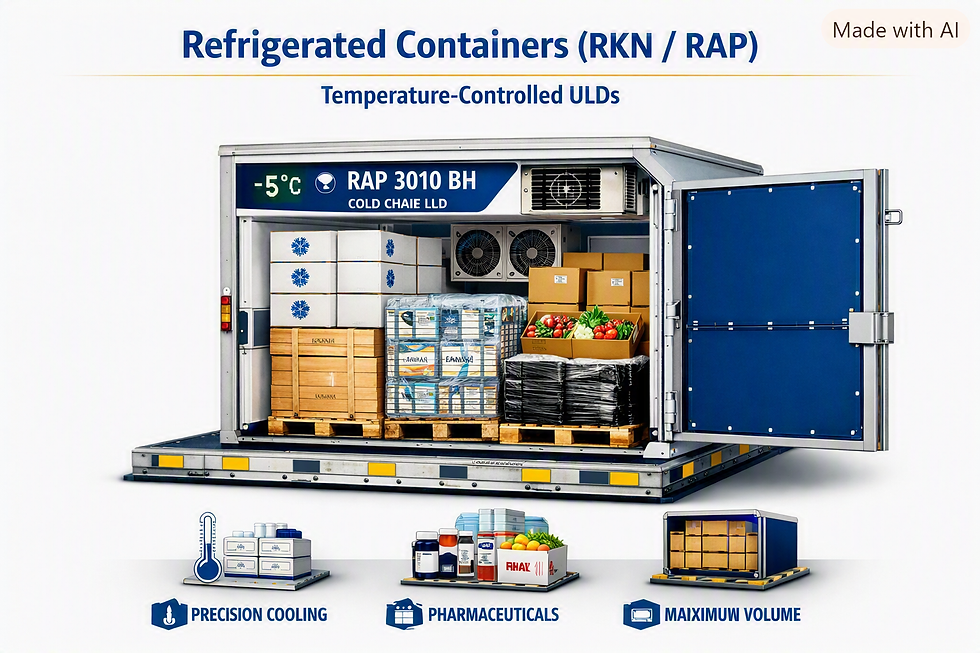
Specialized containers for sensitive cargo requiring active cooling.
Temperature range: typically −20°C to +20°C
Typical cargo: pharmaceuticals, biotech, perishables, high‑value goods
Why it matters: Ensures compliance with GDP and cold‑chain requirements.
5. Open‑Top & Half‑Height Containers For Oversized or Dense Cargo

Used when cargo cannot fit through standard doors or requires vertical loading.
Typical cargo: engines, industrial parts, mining equipment, stone, metal
Why it matters: Provides flexibility for non‑standard freight profiles.
Are you also interested in the detailed dimensions of air containers in Goodloading? Check out our article: Air containers – dimensions and characteristics.
🧩 Why ULD Selection Matters in Modern Logistics
Choosing the correct ULD impacts:
Cargo safety proper restraint and contour fit
Aircraft compatibility avoiding last‑minute reloading
Cost optimization maximizing usable volume and chargeable weight
Operational efficiency faster acceptance at the terminal
Regulatory compliance ULDs are certified aircraft equipment
For companies working across Europe, the Middle East, and Asia, ULD selection is often the difference between a smooth transit and costly delays.
🔧 How Goodloading Enhances ULD Planning
(Business Hand Sàrl Integration Perspective)
Goodloading provides a practical advantage for logistics teams by allowing them to simulate ULD loading before the cargo reaches the airport.
Key benefits:
ULD‑specific 3D visualization See how freight fits inside LD3, LD7, LD9, or on PMC/PAG pallets.
Automatic palletization Loose cargo can be assembled onto pallets digitally, reducing rework at the terminal.
Volume & weight optimization Identify the best ULD type based on dimensions, density, and stacking rules.
Scenario comparison Compare loading outcomes across multiple ULD types to select the most cost‑effective option.
API integration Business Hand Sàrl supports companies in connecting Goodloading’s API to internal TMS/WMS systems, enabling automated load‑planning workflows.

For forwarders, consolidators, and shippers, this means fewer surprises, fewer manual adjustments, and more predictable air‑freight operations.
🤝 Future Collaboration Idea: Business Hand Sàrl & IATA Training Center
As the air‑cargo industry continues to digitalize, Business Hand Sàrl sees strong potential for a future collaboration with the IATA Training Center in Geneva. The idea is simple: combine IATA’s globally recognized training programs with Business Hand’s practical load‑planning expertise and the powerful visualization capabilities of Goodloading.

Such a partnership could give trainees hands‑on exposure to modern ULD planning, palletization logic, and cargo‑space optimization skills that are increasingly essential in today’s air‑freight operations. While this is only a concept at the moment, it represents a promising direction for enhancing professional education and preparing the next generation of logistics specialists for digital‑first cargo management.

🛫 Final Takeaway for Business Hand Clients
ULDs are not just containers they are strategic assets in air‑cargo planning. Mastering their characteristics allows logistics professionals to:
reduce handling time
avoid costly reloading
optimize chargeable weight
improve routing flexibility
enhance customer reliability
With tools like Goodloading, companies can bring clarity and precision to ULD planning, transforming a traditionally manual process into a modern, data‑driven workflow.
Find more articles on Air freight Goodloading Blog


Comments