

Swiss Companies: How Much Unused Volume Are You Losing? And Why a Free 3D Test Can Show You the Real Cost Within 24 Hours
- Ilian Gueorguiev

- 3 hours ago
- 3 min read
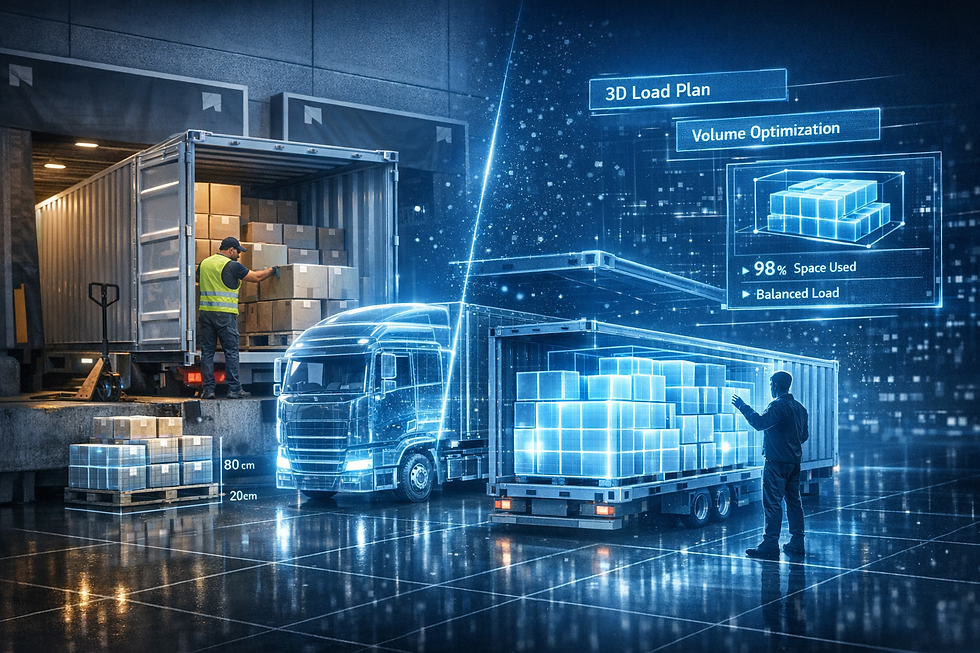
In Swiss logistics and manufacturing, every centimetre inside a truck or container has a price. When that space is not used efficiently, companies pay for air — in the form of extra kilometres, additional vehicles, higher fuel consumption, more labour hours, and unnecessary CO₂ emissions.
Yet most organisations still plan their loads manually or “by eye”, relying on experience rather than data. The result is predictable: unused volume, axle overloads, unstable loads, and avoidable transport costs.
To demonstrate how quickly these losses can be reduced, I offer a free 3D loading plan based on your real cargo case — prepared in English, German or French, and delivered within 24 hours.
This article explains who benefits most, what data is needed, and what you receive.
Why Swiss Companies Lose Money on Unused Volume
Switzerland has one of the most expensive logistics environments in Europe. High labour costs, strict regulations, and tight delivery windows make efficiency essential. Yet even well‑organised companies face recurring challenges:
mixed cargo with different sizes and weights
irregular or bulky items
last‑minute order changes
manual loading plans that leave unused space
axle overloads or uneven weight distribution
lack of clear instructions for warehouse teams
These issues affect both manufacturers and logistics providers.
Who Benefits Most from 3D Cargo Space Optimisation
Swiss Manufacturers in:
furniture & interior solutions
food & beverages
cosmetics, pharma & FMCG
textiles, footwear & finished goods
These sectors ship high‑mix, high‑volume goods where every centimetre matters. Even a small improvement in utilisation can reduce the number of weekly trips.
Swiss Logistics Companies that:
run LTL/groupage lines and need better volume utilisation
operate FTL routes but often leave unused space
ship mixed loads with different sizes and weights
face axle overload or uneven distribution
prepare loading plans manually
serve manufacturers who require accuracy and predictability
want to reduce the number of trips or optimise transport costs
need clear visual loading instructions for warehouse teams
For these companies, 3D planning is not a luxury — it is a competitive advantage.
The Free 3D Test: What It Includes
To show the real impact of optimisation, I prepare one complete 3D loading plan for free, using your real data.
What to send me
📦 Cargo data
dimensions (L × W × H)
weight
number of pallets/boxes/items
special constraints (stackability, orientation, fragility)
🚚 Vehicle data
internal loading space dimensions
maximum allowed weight
axle limitations (if applicable)
🛣️ Short description of your real case
what you are loading
route
issues you face (unused volume, overload, loading chaos, etc.)
What You Receive Within 24 Hours
📦 3D visualisation of the loading layout
📉 exact volume utilisation and optimisation potential
🚚 an executable optimal loading plan
🧾 a PDF for your warehouse team or carrier
⏱ delivery time: 24 hours
This is not a theoretical example — it is your real case, optimised.
Why This Matters
Unused loading capacity is one of the most expensive hidden costs in transport. 3D planning delivers measurable improvements:
fewer trips
lower transport costs
fewer manual errors
predictable loading
clear instructions for warehouse teams
reduced CO₂ emissions
better customer satisfaction
In a market where margins are tight and expectations are high, optimisation is no longer optional.
Ready to See Your Real Savings?
Send me your cargo and vehicle data, or simply message me with your case. You will receive a complete 3D loading plan — free, accurate, and ready to use.
You can also book a Free Consultation+Free 3D Load Test🚚📦 here


Comments